Jun 18, 2021 | News
The Center for Biosimilars has announced that MGA’s recent report, “How Patent Thickets Constrain the US Biosimilars Market and Domestic Manufacturing,” was the top-read article on its website for the week of June 14, 2021.

Jun 10, 2021 | News
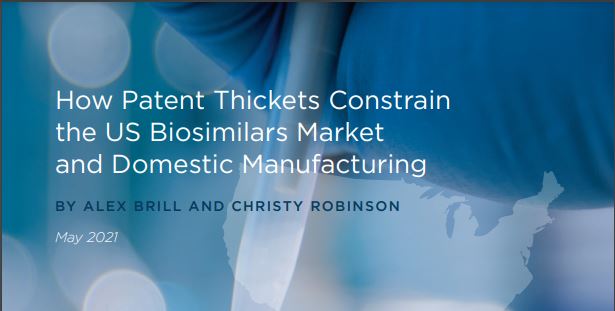
On Thursday, The Center for Biosimilars, a sister site of The American Journal of Managed Care, published an article discussing the differences between the patent systems in the United States and Europe when it comes to biosimilars. The article featured the latest report released by MGA, and authored by Alex Brill and Christy Robinson, titled “How Patent Thickets Constrain the US Biosimilars Market and Domestic Manufacturing”:
May 24, 2021 | Press Releases
“How Patent Thickets Constrain the US Biosimilars Market and Domestic Manufacturing,” authored by Alex Brill and Christy Robinson, explains how reference biologic manufacturers create thickets of overlapping, weaker follow-on patents to keep competitors from entering the market. The paper highlights how originators have strong incentives to protect their profit streams and have found patent thickets to be an easy way to significantly extend the duration of monopolies in the US, preventing access to more affordable medicines for patients.

Jul 14, 2020 | News
“‘One of the ways to align these incentives would be for CMS, in particular the Center for Medicare & Medicaid Innovation, to launch a demonstration project, a shared savings program in Medicare Part B for biosimilars. This would reward physicians for increasing their utilization of biosimilars, which would both create that incentive for physicians and align that incentive with the desire of taxpayers to lower overall costs in the biologic spend category,’ [Alex Brill] said.”

Jun 10, 2020 | News
“The establishment of a shared savings model has the potential to increase health care savings, biologic competition, and biosimilar utilization if implemented in Medicare Part B, according to Alex Brill, founder of Matrix Global Advisors (MGA) and a resident fellow at the American Enterprise Institute (AEI), who makes the case in a new research paper.”