
Mar 31, 2017 | Op-Eds
Pundits have posited every imaginable reason for the failure of the GOP to get their health care reform bill through the first big hurdle: passage on the House floor. As we all know too well, Speaker Ryan pulled the bill just minutes before a vote was scheduled, when it was absolutely clear that a majority of support could not be reached. But would success have ushered in a new health care paradigm? I doubt it.

Mar 29, 2017 | Interviews
“If the tax incentive [for charitable giving] goes away, people will still undoubtedly give to charity, said Alex Brill, research fellow at AEI who published the findings. The AEI model accounts for it. But gifts from wealthy donors could decrease significantly. ‘There’s consensus that the tax break definitely matters. People are always going to quibble about the exact magnitude of the impact,’ Brill said, citing end-of-the-year giving as one example.

Feb 23, 2017 | Interviews
“The Trump administration could face some trouble getting its tax reform through by August, [said] Alex Brill…. ‘There’s only so much that Congress can process at the same time. I was very pleased to hear [Treasury Secretary Mnuchin] put an emphasis and a priority on tax reform, an aggressive schedule of a bill signing in August, but we do need to recognize that there’s a whole other conversation in Washington about [Affordable Care Act] repeal, repeal and replace, or repeal and repair that is potentially in conflict,’ simply due to time constraints, Brill said.”
Feb 10, 2017 | Interviews
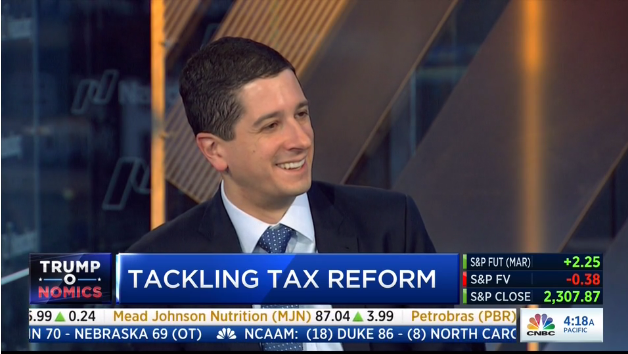
“Tax reform is by definition a game about winners and losers. If there aren’t winners and losers, it’s not tax reform. So there should be no surprise that there are people who are upset about the things that are being discussed, but that doesn’t make it a bad idea…. The idea…is to create a level playing field. There are winners and losers today as a result of the tax code, and if we can clean that system up, we can create fairness between debt and equity, between corporate and non-corporate, between domestically domiciled corporations and foreign competitors.”

Jan 30, 2017 | Op-Eds
If the House Republican plan for a border adjustment tax were adopted, many large U.S. multinationals and others net exporters would receive more tax subsidy on their exports than tax owed on their other business activities. Without refundable credits, a 20% border adjustment tax would actually yield $260 billion in revenue beyond the expected $1 trillion.